
AI in LogicManager: Intentional AI for Enterprise Risk Management
AI should help risk professionals make better decisions—not replace them.
At LogicManager, we believe the most effective artificial intelligence solutions are intentional, transparent, and grounded in human oversight. That’s why our AI capabilities are designed to support your expertise, accelerate repetitive work, and surface meaningful insights while keeping people firmly in control of the final decision.
Whether you’re managing risk in banking, healthcare, education, or other highly-regulated industries, LogicManager’s AI for enterprise risk management helps you work smarter without sacrificing accountability, oversight, or confidence.

Why LogicManager Takes a Human-Centered Approach to AI
Generic AI tools can generate answers quickly, but they often lack the organizational context, governance structure, and explainability that risk professionals need. In highly regulated and operationally complex environments, unchecked automation can introduce more uncertainty instead of reducing it. That’s why LogicManager’s AI is intentionally designed to:
- Assist—not replace—human decision-making
- Provide recommendations and insights while enabling review and approval workflows
- Operate within your organization’s oversight structure and taxonomy
- Help teams identify risks and connections they might otherwise miss
- Reduce manual work without removing accountability
- Maintain separation of duties and oversight across critical processes
Our philosophy is simple: AI should empower experts, not sideline them.
How AI Works in LogicManager Today
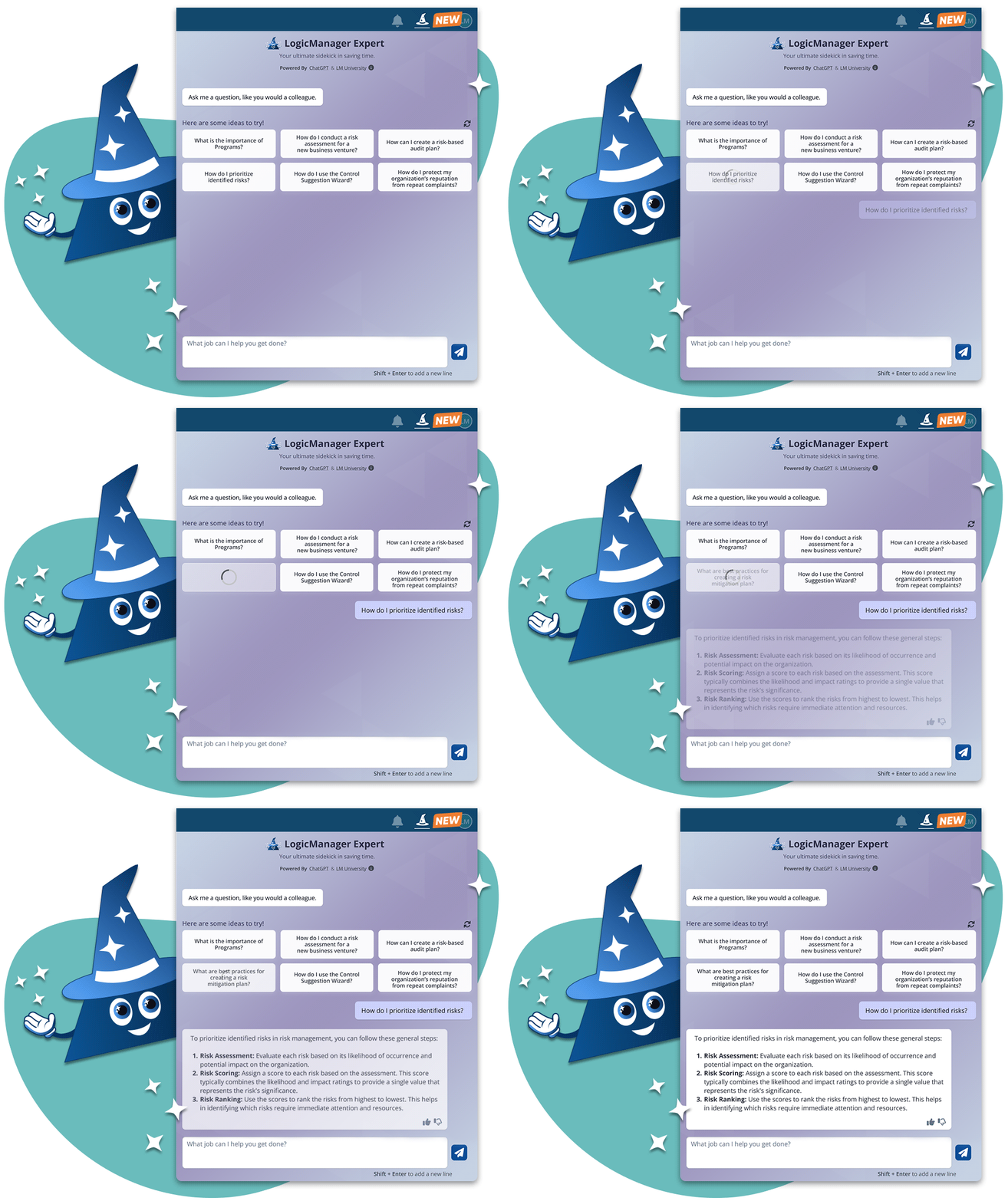
LogicManager Expert (LMX)
Turn every user into a confident risk contributor.
Risk management only works when people across the business know what to do, when to do it, and why it matters. But not every employee is a risk expert—and they shouldn’t have to be.
LogicManager Expert (LMX) gives users AI-powered guidance at the moment they need it, helping teams take the next right step without slowing down, guessing, or waiting for support.
Powered by OpenAI technology and trained on LogicManager University knowledge materials, LMX delivers practical answers grounded in LogicManager’s platform, risk management best practices, and real-world execution.
With LMX, teams can:
- Get risk management best-practice guidance in context
- Follow step-by-step instructions for completing work in LogicManager
- Quickly find relevant LogicManager University resources
- Escalate to LogicManager Support directly when additional help is needed
The result: more people can participate in risk management with confidence, consistency, and accountability.
LMX helps organizations scale expertise across departments, reduce confusion, and keep work moving—so risk management becomes part of how the business operates, not another task people avoid.
Document Analyzer Powered by LMX
Important risk information is often buried in policies, contracts, SOC reports, regulatory updates, and other documents. Manual review takes time, and key details can be missed.
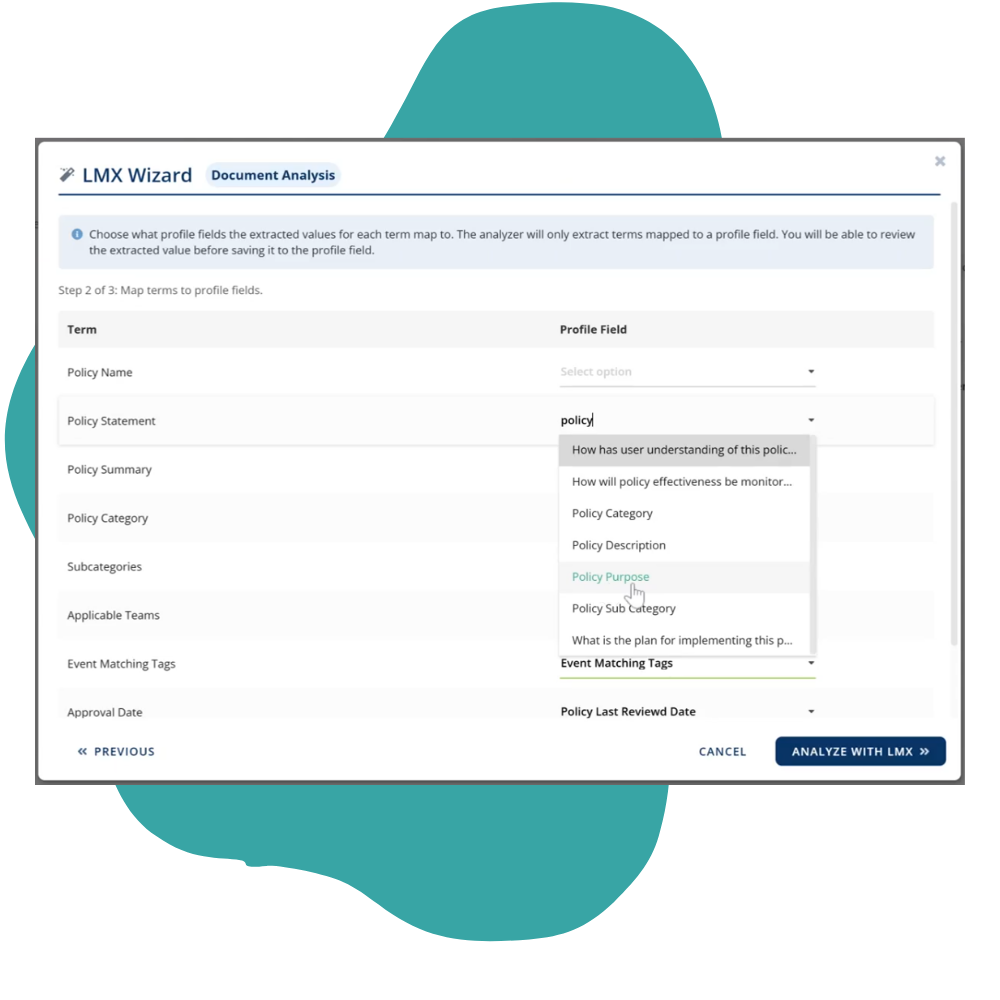
Document Analyzer powered by LMX helps turn static documents into actionable risk data.
With Document Analyzer, teams can:
- Extract key terms and details from documents
- Reduce manual data entry
- Identify information that may require review or follow-up
- Trigger workflows based on extracted insights
- Support policy reviews, vendor assessments, and audit preparation
- Connect document details to risks, controls, vendors, and processes
For example, if a policy includes a review date and policy owner, LogicManager can help extract those terms and support the next step in the review workflow. If a contract, policy, or report references an area connected to third-party data handling, the right stakeholders can be notified through LogicManager’s connected risk structure.

Risk Ripple Analytics: AI-Powered Insight and Automation
Reveal the connections that turn hidden risk into actionable intelligence.
Risk does not stay neatly inside one department. A vendor issue can disrupt operations. A regulatory change can affect policies, controls, applications, third parties, and reporting obligations. A small gap in one process can quietly create exposure across the enterprise.
That is why disconnected risk management fails. When teams manage risks, controls, policies, vendors, and assets in isolation, they miss the relationships that determine true impact.
LogicManager’s Risk Ripple Analytics helps organizations see how risk moves through the business by connecting data across the enterprise. Using AI-powered suggestions and LogicManager’s connected taxonomy, Risk Ripple Analytics reveals relationships that may otherwise stay hidden—so teams can understand what is connected, what is exposed, and what needs attention.
With Risk Ripple Analytics, teams can:
- Connect policies, controls, vendors, resources, applications, and risks at the point of need
- Identify effective controls for risks that are currently unmitigated
- Uncover gaps in coverage before they become failures
- Understand downstream impact when risks, requirements, or processes change
- Turn isolated data into a connected view of enterprise risk
The outcome: better decisions, faster action, and fewer blind spots.
Risk Ripple Analytics transforms risk management from a siloed, reactive process into a connected, proactive discipline. AI becomes the bridge between departments, data, and decisions—helping every team navigate the complex web of risk interdependencies with confidence.
Why Human Oversight Matters in AI Risk Management
As organizations adopt AI more broadly, many are discovering that automation without governance creates new forms of operational, compliance, and reputational risk.
Unchecked AI can lead to:
- Inaccurate or misleading outputs
- Loss of accountability
- Poor auditability
- Inconsistent decision-making
- Regulatory concerns
- Overreliance on automation
- Oversight gaps across departments
LogicManager takes a different approach.
Our AI capabilities are designed to enhance governance by keeping humans involved in critical decision-making processes.
That means organizations can:
- Accelerate work without sacrificing control
- Improve consistency while maintaining flexibility
- Reduce manual effort while preserving accountability
- Gain insights while supporting governance best practices
- Use AI confidently within existing risk management frameworks

AI should help organizations make better decisions—not create blind spots. Book a demo to see our AI in action and discover how you can empower your organization to uphold their reputation, anticipate what’s ahead, and improve business performance through strong governance. Current customers can review our AI Governance to understand how LogicManager puts this into practice.