
25 Million Victims: The Vendor Risk Failure Behind the Conduent Breach
Last Updated: March 13, 2026
When most people hear about a data breach, they assume the story is about hackers. In reality, it is far more often a failure of risk oversight, where organizations lack the visibility and documented controls needed to demonstrate that risks were responsibly managed.
The Conduent data breach, which has exposed sensitive personal and medical information associated with roughly 25 million individuals, illustrates how quickly third-party relationships can transform into enterprise-level risk events. Conduent operates behind the scenes for government agencies, healthcare systems, insurers, and large employers, processing data that organizations entrust to the company as part of critical operational services. When attackers gained access to those systems, the consequences did not stop with the vendor—they extended to every organization that depended on Conduent to handle sensitive data on its behalf.
So far, Conduent has reported approximately $25 million in breach-response costs, but the financial exposure tied to incidents like this rarely remains isolated to the vendor itself. Organizations that rely on the affected provider must often manage regulatory notifications, customer communications, internal investigations, and reputational fallout—even when their own systems were never compromised.
For risk leaders responsible for overseeing vendor relationships, the Conduent incident highlights a fundamental challenge of modern oversight. Businesses increasingly rely on third parties to operate essential processes, yet those same relationships expand the organization’s risk surface far beyond its own infrastructure.
The Conduent breach demonstrates how oversight gaps within third-party ecosystems can rapidly translate into operational, regulatory, and financial consequences for the organizations that depend on them.
Risk leaders often discuss vendor risk in theoretical terms—questionnaires, due diligence reviews, and contractual controls designed to ensure third parties meet security and compliance expectations. Incidents like the Conduent breach show how quickly those theoretical risks can become operational realities.
Understanding what actually happened provides important context for why vendor oversight must extend beyond initial due diligence and into ongoing risk management.
What Happened in the Conduent Data Breach
Conduent is not widely known outside the industries it serves, but the company plays a critical role in the operational infrastructure of many organizations across the United States. Government agencies, healthcare providers, insurers, and large employers rely on Conduent to process sensitive data and support essential administrative services, including benefits administration, payment processing, and claims management.
Because of this role, Conduent systems often contain large volumes of highly sensitive information belonging to multiple organizations and the individuals they serve.
In early 2026, the company disclosed that attackers had gained unauthorized access to systems containing this data. As investigations progressed, the scope of the incident expanded significantly. What initially appeared to be a more limited breach ultimately affected information associated with approximately 25 million individuals.
The compromised data reportedly includes:
- Social Security numbers
- medical information
- insurance details
- addresses and dates of birth
For organizations that rely on Conduent’s services, the implications extend far beyond the individuals whose information was exposed. A breach involving a service provider can trigger regulatory notifications, internal investigations, and operational disruption across every organization connected to that vendor.
Incidents like this highlight a fundamental challenge of modern business operations: when organizations outsource critical processes to third parties, they also inherit the risks embedded within those vendors’ systems.
How much risk are you actually outsourcing when you rely on third-party vendors?
Why the Conduent Breach Matters to Every Organization
So far, Conduent has disclosed approximately $25 million in breach-response costs, including forensic investigations, regulatory filings, and customer notification efforts.
However, the financial impact of incidents like this rarely remains isolated to the vendor itself. When a third-party provider experiences a breach, the organizations that rely on that vendor often face their own cascade of costs. They may need to notify affected customers, provide credit monitoring services, respond to regulators, and conduct internal investigations—all because data entrusted to a service provider was compromised.
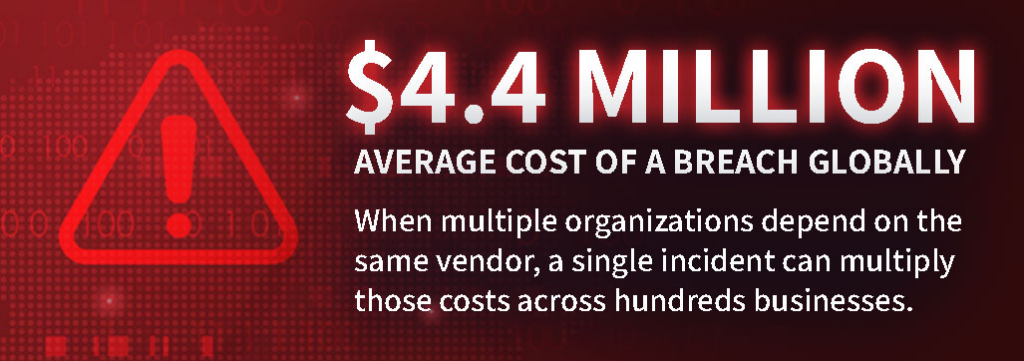
These expenses escalate quickly. According to IBM’s Cost of a Data Breach Report, the average cost of a breach is $4.45 million globally and nearly $9.5 million in the United States. When multiple organizations depend on the same vendor, a single incident can multiply those costs across hundreds of businesses.
Operational disruption can also ripple outward. Services supported by Conduent systems were temporarily interrupted in some jurisdictions, illustrating how a breach at a single vendor can disrupt government programs and business operations that depend on those systems.
Legal exposure adds another layer of risk. The incident has already triggered multiple class-action lawsuits alleging negligence in the handling of sensitive data. Even organizations whose own systems were never compromised may still face regulatory inquiries, contractual disputes, and reputational damage as a result of their connection to the affected vendor.
This is the hidden financial reality of vendor risk. When a critical third-party provider fails, the consequences rarely remain contained within that company. They propagate across every organization connected to the vendor—and ultimately to the customers and citizens those organizations serve.
The Real Problem: Third-Party Risk Blind Spots
Incidents like the Conduent breach are often framed as cybersecurity failures. While the attack itself is significant, focusing exclusively on the technical intrusion overlooks the deeper issue.
The underlying problem is limited visibility into third-party risk.
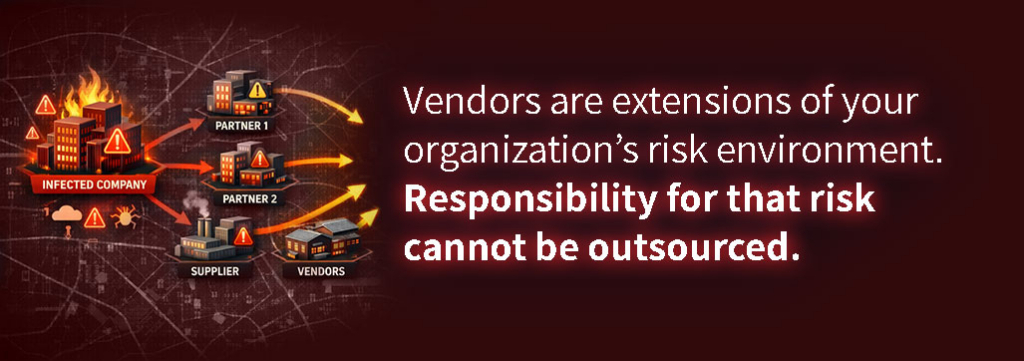
Organizations increasingly rely on vendors to store sensitive data, operate critical systems, and support processes that are essential to daily operations. In many cases, these vendors function as extensions of the organization’s risk environment, supporting activities that directly affect customers, employees, and regulatory obligations.
Yet organizations often have only partial insight into how those vendors:
- store and protect sensitive data
- secure critical systems
- monitor and respond to emerging threats
- control internal access to sensitive environments
- manage vulnerabilities within their infrastructure
Even organizations with mature vendor risk management programs frequently depend on periodic questionnaires, annual assessments, or static compliance documentation to evaluate their third parties. While these practices provide a level of due diligence, they offer only point-in-time snapshots of vendor risk.
In complex vendor ecosystems, snapshots are rarely sufficient. Risk conditions can change quickly as vendors update systems, introduce new technologies, or expand their own third-party relationships.
Without ongoing oversight, organizations may not detect emerging exposures until an incident has already occurred. And when vendors function as extensions of an organization’s risk environment, those blind spots can create opportunities for fraud, waste, and negligence to develop unnoticed until the consequences are significant.
The Conduent breach illustrates the challenge clearly: when organizations depend on third parties to operate critical systems but lack continuous visibility into those environments, small oversight gaps can quickly evolve into enterprise-level risk events.
The Risk Ripple: How Vendor Failures Spread Across Organizations
This is where vendor risk becomes a systemic oversight challenge.
When organizations rely on a common service provider, a single breach can create consequences that extend far beyond the vendor itself. A compromise within the vendor environment can expose data belonging to multiple organizations simultaneously, triggering regulatory notifications, customer communications, operational disruptions, and reputational damage across institutions that may have had no direct role in the incident.
In these situations, the impact of a breach does not remain isolated. It spreads outward through the network of organizations connected to the vendor.
One incident becomes many organizations’ crisis.
In an interconnected economy, risk behaves less like an isolated event and more like a network phenomenon. A failure in one node can quickly propagate across the entire system, affecting organizations that may have had little visibility into the conditions that allowed the incident to occur.
This dynamic is why effective vendor risk management requires more than siloed assessments or periodic reviews. Organizations must develop oversight practices that recognize how risks move across interconnected relationships and how failures within one organization can rapidly affect many others.
What the Conduent Breach Teaches About Vendor Risk Management
The Conduent breach reinforces a lesson that organizations continue to learn the hard way:
Risk can be outsourced operationally, but responsibility for that risk cannot be outsourced.
When organizations rely on third parties to perform critical functions, their systems, security practices, and operational controls directly influence the organization’s exposure to regulatory, operational, and reputational risk.
For that reason, vendor risk management cannot be treated as a one-time due diligence exercise. Questionnaires, contractual assurances, and periodic assessments provide useful information, but they offer only limited visibility into the evolving risks within a vendor environment.
It is also important to recognize that organizations cannot eliminate every risk introduced by third-party vendors. Breaches, operational failures, and security incidents can still occur even when reasonable precautions are in place. The objective of effective oversight is not eliminating all vendor risk—it is ensuring that organizations maintain the visibility, documentation, and controls necessary to demonstrate responsible risk management and prevent failures caused by negligence.
Effective oversight requires organizations to understand not only their own internal risks, but also the risks embedded within the broader vendor ecosystem that supports their operations.
Vendor risk is no longer a peripheral concern. In a highly interconnected business environment, it sits at the center of modern risk oversight.
How Organizations Can Prevent Vendor Risk Failures
Incidents like the Conduent breach highlight several practices organizations should adopt when managing third-party risk.
- Identify critical vendors
Not all vendors create equal exposure. Organizations must identify which vendors process sensitive data, support essential services, or operate systems that could disrupt critical business activities. A risk-based approach ensures that oversight efforts focus on the vendors whose failures would create the greatest operational, regulatory, or reputational impact. - Establish clear oversight responsibilities
Vendor relationships require ongoing oversight, not simply contractual obligations. Internal stakeholders must be accountable for monitoring vendor performance, security practices, and compliance requirements. - Continuously monitor vendor risks
Annual reviews and questionnaires cannot keep pace with evolving threats. Vendor risk conditions can change quickly as technologies evolve, systems are updated, or vendors introduce their own third-party dependencies. - Connect vendor risk to enterprise risk management
Third-party risk should be integrated into the broader enterprise risk management program, so risk leaders can understand how vendor failures could affect operational, regulatory, and strategic objectives.
Organizations that treat vendor risk as an isolated compliance exercise often discover problems only after an incident has already occurred.
Why Vendor Risk Requires a Connected View of Risk Oversight
As organizations rely on increasingly complex vendor ecosystems, managing third-party risk requires more than static assessments.
Risk leaders must be able to see how vendor risks connect to operational, regulatory, and reputational exposures across the organization. This requires a more integrated approach to oversight—one that recognizes how risks move through interconnected relationships rather than remaining confined to individual systems or organizations.
In modern vendor ecosystems, failures rarely remain isolated. They propagate through networks of organizations that depend on the same providers and infrastructure.
The Conduent breach illustrates this dynamic clearly. When oversight breaks down within a vendor environment, the consequences extend far beyond the vendor itself—affecting every organization connected to that provider.
For risk leaders, the challenge is not simply responding to these ripple effects after they occur. The real objective is identifying critical vendor risks early and establishing the oversight needed to reduce exposure and demonstrate responsible risk management before failures spread across the organization’s broader risk environment.
In interconnected vendor ecosystems, organizations cannot eliminate every risk introduced by third parties. But with risk-based oversight and well-documented controls, they can ensure that when incidents occur, they are recognized as unavoidable events—not the result of negligence.