
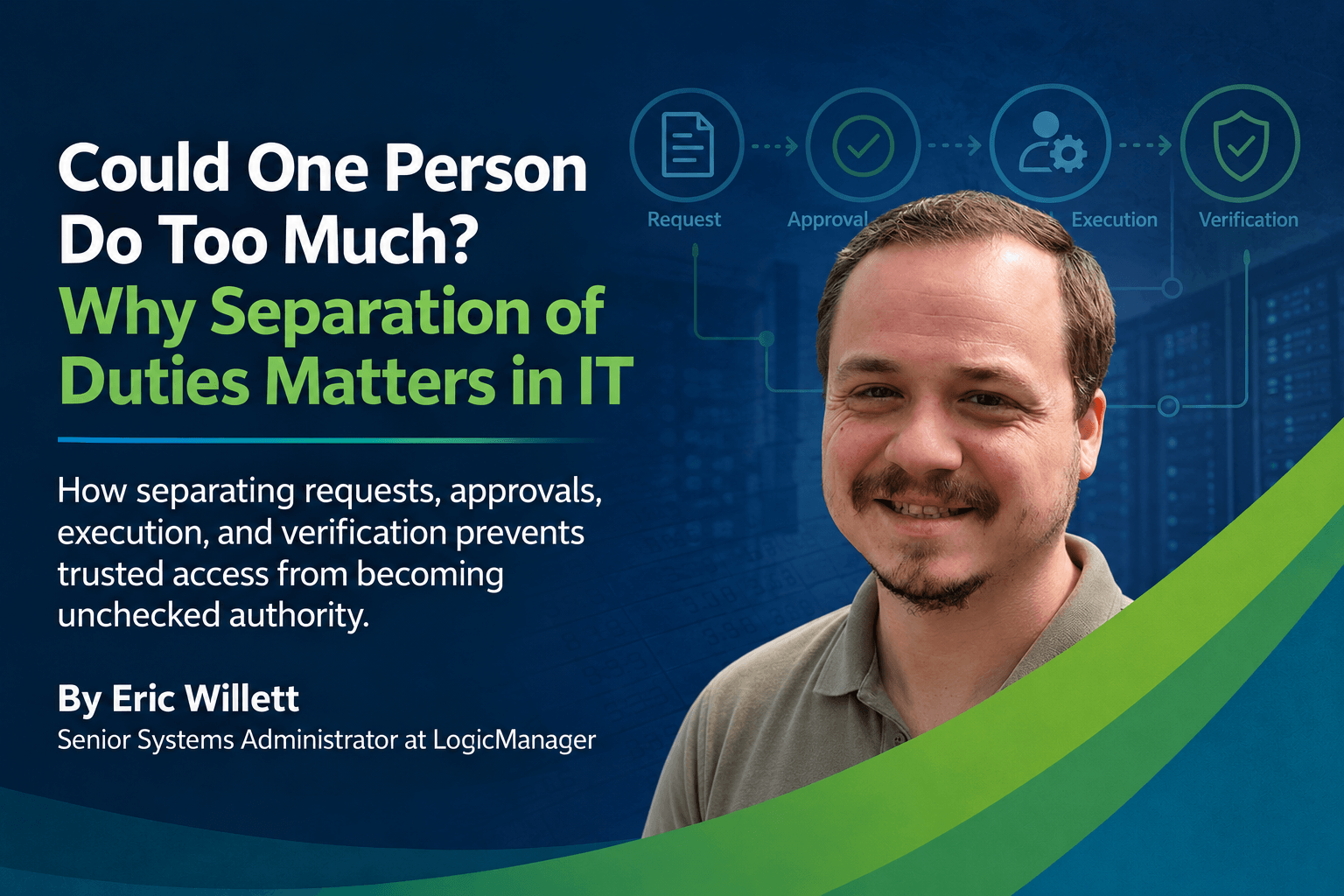
In IT, access requests often look simple. Someone needs a new account, a different permission, a password reset, or a system change. The request may be routine, the deadline may be tight, and the person completing it may be someone the organization trusts.
The risk is not always in the request itself. The risk increases when the same person can request the change, approve it, make it, and confirm that it was appropriate, all without independent visibility.
The harder question is whether you could identify where that is happening in your environment today.
That is why separation of duties matters in IT. It is not just a compliance requirement or an audit exercise. It is a practical way to reduce the chance that an error, an unauthorized action, or a temporary workaround becomes a larger business problem.
The risk is not always malicious
When people hear “separation of duties,” they often think first about fraud. Fraud is one reason the control exists, but most breakdowns begin in far more ordinary circumstances.
A team is lean. Someone is out of the office. A new employee needs access before a meeting. A vendor is troubleshooting a production issue. An emergency change cannot wait for the normal review cycle. An administrator inherits responsibilities after a role change, but the old permissions are never revisited.
None of those situations automatically means someone did something wrong. They do create conditions where too much authority can collect around one person or one account. If no one else can see the decision, review the action, or verify the result, a reasonable shortcut can quietly become a standing weakness.
From an IT administrator’s perspective, the goal is not to assume bad intent. The goal is to design the process so trust does not carry the entire control environment.
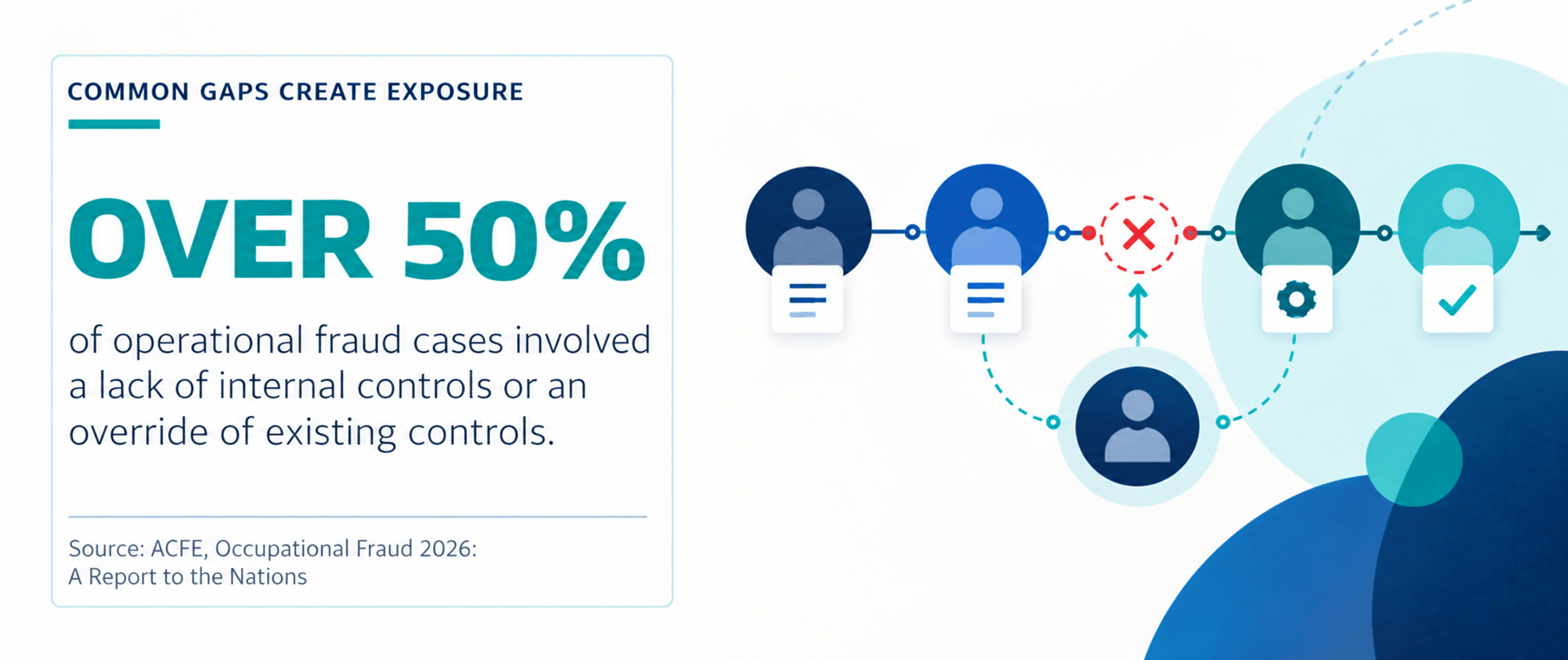
THE PRACTICAL QUESTION
Four responsibilities that should remain visible
A useful way to evaluate separation of duties is to break a critical activity into four responsibilities: initiate, approve, execute, and verify.
| Responsibility | What it means | IT example |
|---|---|---|
| Initiate | Request the activity or change | Request new access or a configuration change |
| Approve | Authorize the request based on need and risk | Confirm business need, scope, and appropriate privilege |
| Execute | Perform the approved activity | Create the account, grant access, or deploy the change |
| Verify | Confirm the result was appropriate and complete | Review logs, reconcile access, or validate the change |
Healthy separation does not require four different people in every situation. It does require clear ownership, an independent checkpoint at the right moment, and evidence that the checkpoint occurred. The design should match the risk and the size of the team. The real test is whether you know where those responsibilities overlap and what independent safeguard exists when they do.
Where separation of duties shows up in everyday IT work
- User access and privileged permissions
The person who needs access should not be the only person deciding what level of access is appropriate. Business ownership, IT administration, and periodic verification each provide a different view of the decision. - Onboarding, role changes, and offboarding
Access should follow the person’s current responsibilities, not accumulate indefinitely. Role changes are especially important because an employee can retain old permissions while receiving new ones, creating combinations that were never intentionally approved. - System changes and deployments
The person building or configuring a change may also be the person best equipped to implement it. Independent approval, testing, or post-change validation helps confirm that speed does not replace oversight. - Vendor and support access
Third parties may need temporary access to diagnose a problem. That access should be scoped, approved, monitored, and removed when the work is complete. Temporary access becomes a lasting risk when no one owns the end of the process. - Emergency access
Break-glass procedures exist because some situations cannot wait. They should also include a time limit, a record of what occurred, and an independent review after the immediate issue is resolved.
Which of these would be hardest for your organization to answer confidently today?
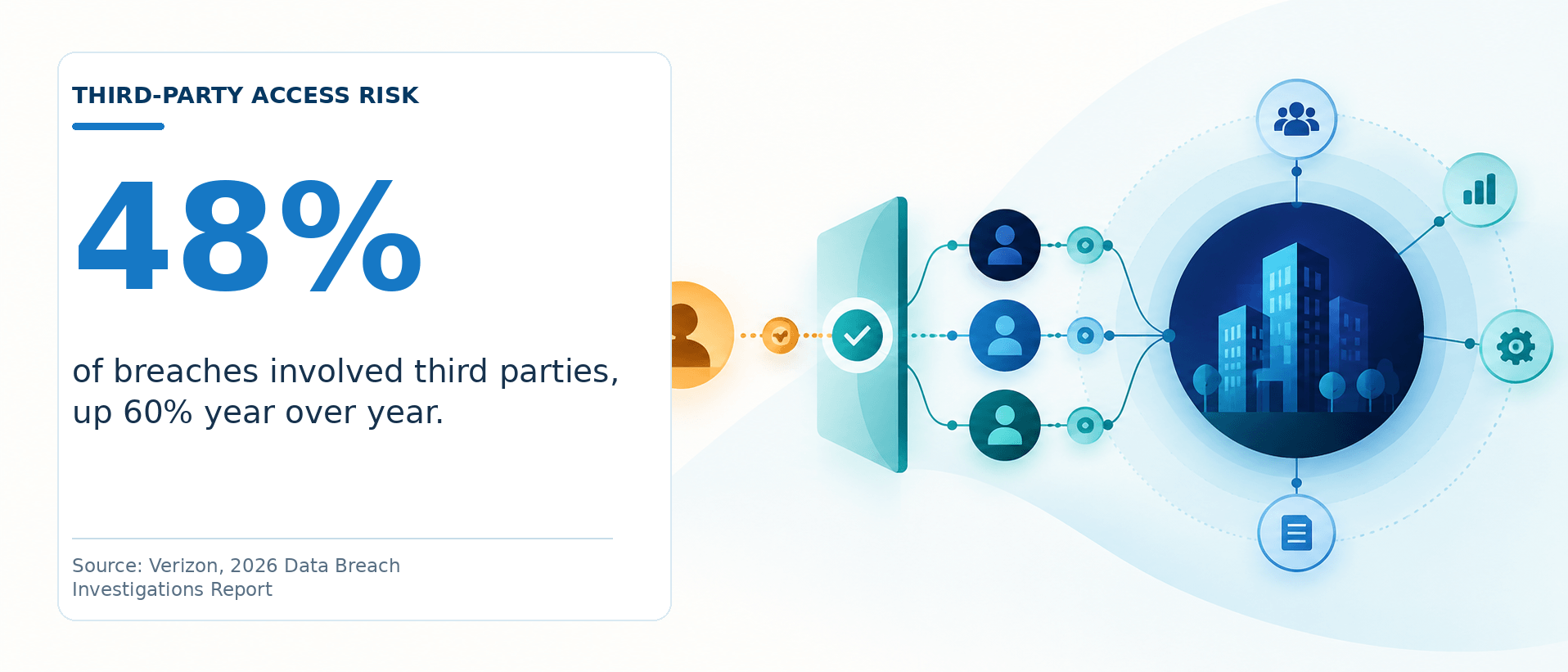
The hardest failures happen between systems and teams
Many organizations can describe how access is supposed to work inside a single system. The harder question is whether they can see responsibility across the full process.
Human Resources may initiate an onboarding or offboarding event. A manager approves business access. IT creates accounts. Application owners assign specialized permissions. Security monitors activity. Finance or Procurement may be involved when licenses or vendors are affected. Each team can complete its own step correctly while the overall handoff still breaks down.
This is where separation on paper can differ from independent oversight in practice. The approval may exist in an email, the change may exist in a service ticket, the evidence may exist in a system log, and the exception may exist in someone’s notes. If those pieces are disconnected, it becomes difficult to answer the questions leadership ultimately depends on:
- Who approved the access and what business needed to support it?
- Who made the change, and was the result independently reviewed?
- Which exceptions are still open, and who accepted the risk?
- Did a temporary permission expire when it was supposed to?
- Where is authority most concentrated today?
Exceptions need more oversight, not less
Perfect separation is not always possible. Small teams have limited coverage. Specialized systems may have only one qualified administrator. An urgent incident may require someone to act before every normal approval can be completed.
The answer is not to pretend those conditions do not exist. The answer is to make the exception visible and add compensating oversight. That can include a second-person review, more detailed logging, a time-bound approval, post-event verification, or leadership acceptance of the remaining risk.
An exception should have an owner, a reason, a duration, a monitoring plan, and an escalation path. If it has none of those things, it is not being managed as an exception. It has become the process.
What good separation looks like
Strong separation of duties is often less dramatic than people expect. It looks like clear requests, appropriate approvals, scoped access, independent review, retained evidence, and exceptions that do not disappear into inboxes or ticket queues.
It also adapts when the organization changes. New systems, reorganizations, turnover, acquisitions, vendor transitions, and staffing gaps can all change who has authority. A control that worked six months ago may no longer provide real separation today.
That is why periodic review matters. The most useful review does not ask only, “Do we have a separation of duties policy?” It asks whether critical responsibilities are still appropriately separated, whether exceptions are still necessary, and whether leadership can see where independent oversight is missing.
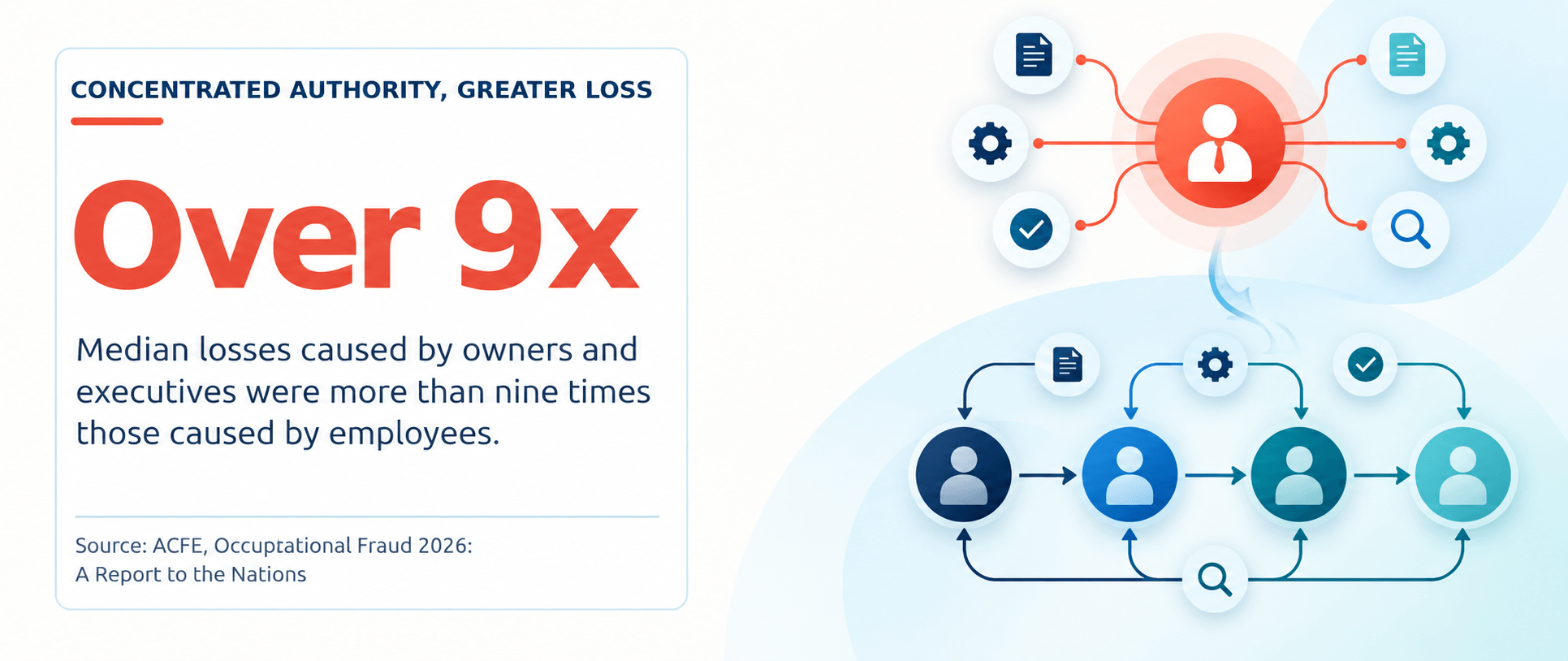
A QUESTION FOR LEADERSHIP
Connecting access, accountability, and business risk
IT teams manage the technical side of access, but separation of duties is not only an IT problem. It is an ownership and oversight problem that crosses systems, processes, vendors, and business functions.
The technical permission matters. So does the process it supports, the risk it creates, the control intended to manage it, the evidence that proves the control worked, and the exception that may require leadership attention. When those elements are managed separately, teams can see activity without seeing the full exposure.
This is where LogicManager’s connected approach becomes valuable. LogicManager links responsibilities to the processes, risks, controls, evidence, exceptions, and outcomes they affect. That gives organizations a clearer view of where authority overlaps, where independent oversight may be missing, and the evidence available to demonstrate whether compensating controls are working as intended.
For IT teams, that connection helps put access and change activity into business context. For leadership, it creates a more reliable way to understand concentration risk, monitor exceptions, and demonstrate accountability without assembling the story manually after an incident or audit request.
The goal is not more bureaucracy. It is making sure no critical activity depends on one person acting without visibility.
Could one person do too much without someone else knowing?
If you’re not sure, that’s worth finding out. See how connected oversight can make those relationships visible at logicmanager.com/platform.