

This is a perspective from my role as Director of Software Development at LogicManager. We’re sharing it because engineering metrics are not just a measure of team activity. When viewed together, they can reveal where delivery risk, quality concerns, customer impact, and operational pressure may be building. Risk management is not theoretical here. It shows up in how teams interpret data, identify patterns, create visibility, and act before small signals become larger business issues.
The value of engineering metrics is not just operational reporting. When connected, they can help teams identify delivery pressure, quality drift, customer impact, and operational risk earlier, before small issues become larger business problems.
Software development teams are not short on metrics.
Most teams track sprint progress, backlog size, defect trends, cycle time, release readiness, support escalations, QA findings, and production issues. These metrics are useful, but they become much more valuable when they are viewed together.
A single metric can tell you what happened at a specific point in time. Like a signal, it can show what one measurement looked like in isolation. But a connected view of metrics tells a broader story. When teams analyze those signals together, they can uncover deeper insights and better understand where risk is building.
That distinction matters. In software development, risk does not always show up first as a major outage, missed release, or customer escalation. More often, it starts as a smaller signal: an increase in carryover work, a recurring defect pattern, a compressed QA cycle, a spike in reopened tickets, or a support trend that keeps resurfacing.
Individually, those indicators may not look urgent. Together, they can tell a very different story.
A Metric Alone Rarely Tells the Full Story
Development metrics are often reviewed in isolation.
Cycle time may show how quickly work is moving. Defect trends may show quality concerns. Backlog growth may show capacity or prioritization pressure. Support escalations may show where customers are experiencing friction.
Each metric has value, but none of them tells the full story on its own.
For example:
- A team may be closing tickets quickly, but defects are increasing.
- A sprint may look complete, but carryover work keeps growing.
- A release may still be on schedule, but QA is being compressed at the end.
- A backlog may be growing, but the real issue may be unclear prioritization or shifting requirements.
This is where engineering metrics become more than operational reporting. They become leading indicators.
The goal is not to measure everything. The goal is to understand what the right metrics are telling us about delivery health, quality, customer impact, and team performance.
This Started Long Before We Called It “Risk Insight.”
A lot of this thinking did not start with dashboards or reporting discussions. It started with delivery challenges.
A few years ago, during our LogicManager 2.0 transformation work, the focus was on improving how Development, QA, Product, and leadership collaborated across the software delivery lifecycle.
At the time, the goal was not “risk management” in the traditional sense. The goal was to create better visibility into how work moved, where bottlenecks formed, and how teams could make more informed decisions earlier.
What became clear very quickly was that engineering metrics were rarely isolated operational data points.
Cycle time is connected to dependency management. Reopened tickets connected to requirements clarity. Escaped defects connected to release readiness. Support escalations connected directly to customer experience.
Viewed independently, those looked like team-level metrics. Viewed together, they started revealing broader operational patterns.
That experience helped shape how we think about engineering signals today. Not simply as measurements of activity, but as indicators that can help teams identify where delivery pressure, quality concerns, customer impact, or operational risk may be building before issues become visible at the business level.
The Metrics That Matter Most Together
Strong development performance is not measured by one number.
It is not just how many tickets were closed, how fast the team moved, or whether a release went out on time. A stronger view looks at delivery, quality, customer impact, rework, and sustainability together.
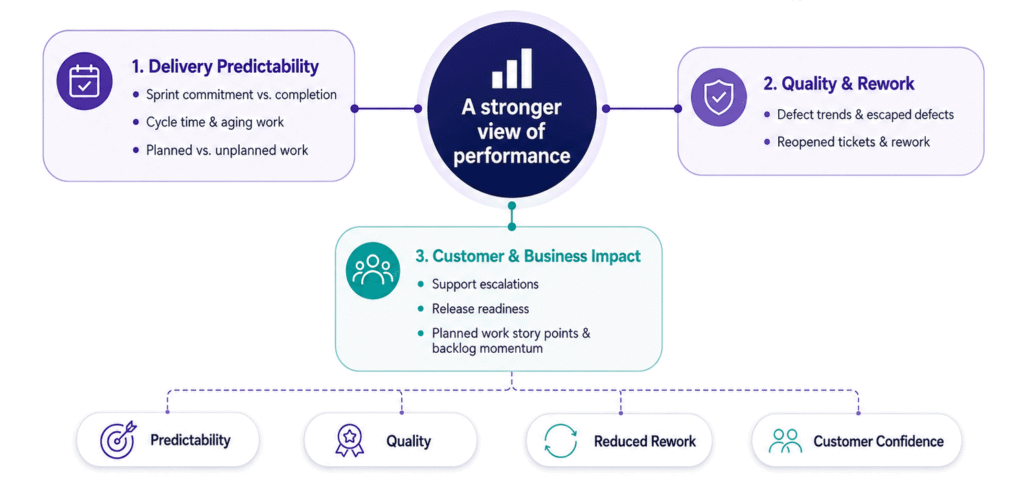
Delivery Predictability
- Sprint commitment vs. completion helps show whether the team can plan and deliver reliably.
- Cycle time and aging work help reveal where work is getting stuck.
- Planned roadmap work vs. unplanned work helps show whether the team is focused on strategic priorities or constantly reacting to interruptions.
Quality & Rework
- Defect trends and escaped defects show whether quality is holding up before and after release.
- Reopened tickets and rework help identify whether requirements, testing, or acceptance criteria need more clarity.
Customer & Business Impact
- Support escalations tied to product issues connect engineering performance directly to customer experience.
- Release readiness indicators help teams understand whether testing, documentation, dependencies, and validation are complete before release.
- Total release story points for planned work can indicate how much of the product backlog is being reduced with each release. Lower values may signal backlog growth risk, while higher-than-average values may indicate stronger delivery momentum and increased capacity to move priority work forward.
Viewed together, these metrics give leaders a more complete picture of performance. They show not only whether work is getting done, but whether it is being delivered predictably, with quality, and in a way that supports customers and the business.
The goal is not to measure developer activity.
The goal is to understand whether the team is delivering predictably, maintaining quality, reducing rework, and creating outcomes the business and customers can rely on.
Reporting Tells You What Happened. Risk Insight Tells You What’s Next
Reporting answers the question: “What happened?”
Risk insight answers a different question: “What could this affect if it continues?”
That shift changes how teams use development metrics.
A delayed ticket is not automatically a risk. But repeated delays in the same area may point to unclear requirements, dependency issues, technical debt, or capacity constraints.
A defect is not always a major issue. But recurring defects tied to the same module, workflow, or customer use case may point to a deeper quality concern.
A support escalation may be isolated. But several escalations tied to the same experience may indicate a product gap, documentation issue, or release-readiness problem.
When teams look at metrics this way, they can move from describing work to improving outcomes. For example, if cycle time increases during one sprint, there may be an elevated risk to quality in the following sprint as teams feel pressure to complete release deliverables on time. The metric is not just showing that work slowed down. It is signaling where pressure may build next.
Where Delivery Risk Usually Starts to Show Up
The most useful development metrics are the ones that help teams make better decisions. Common examples include:
Cycle Time
How long work takes to move from start to completion. Long or inconsistent cycle times may point to unclear scope, bottlenecks, or dependency issues.
Sprint Carryover
How much work regularly moves from one sprint to the next. Repeated carryover may indicate overcommitment, shifting priorities, or work that is not well-defined before it starts.
Defect Trends
How often defects are found, where they appear, and whether they are recurring. This helps teams understand whether quality issues are isolated or systemic.
Escaped Defects
Issues found after release, especially by customers or support teams. These help show whether internal testing and validation are catching the right problems before deployment.
Reopened Tickets
How often work gets marked complete but needs to be revisited. This can point to unclear acceptance criteria, incomplete testing, or misalignment between expected and actual behavior.
Support Escalations
Where customer-facing issues are surfacing after release. These can help connect engineering work to customer experience and business impact.
Planned vs. Unplanned Work
How much team capacity is spent on roadmap priorities compared with urgent fixes, interruptions, or unexpected work.
Release Readiness Indicators
Whether testing, documentation, dependencies, and validation are complete before release.
The value is not in tracking these metrics separately. The value is in understanding how they connect.
Development Metrics Don’t Stay Inside Development
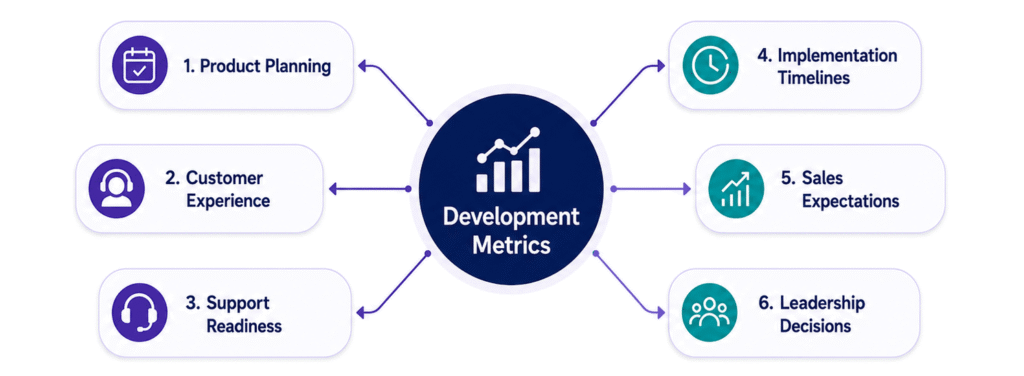
They affect Product planning, customer experience, support readiness, implementation timelines, sales expectations, and leadership decisions.
If a release timeline changes, Product and Customer Success need visibility.
If customer-reported issues are increasing, Support and Engineering need to understand whether the pattern is isolated or broader.
If technical debt is slowing delivery, leadership needs to understand the tradeoff between speed today and capacity tomorrow.
If QA is consistently compressed before releases, that is not just an engineering concern. It may increase the chance of customer-facing issues after launch.
If unplanned work keeps crowding out roadmap priorities, that is not just a capacity issue. It may indicate the organization is spending too much time reacting and not enough time addressing root causes.
This is why development metrics should not be viewed only as team performance data.
They are part of the broader operational risk picture.
From Dashboards to Decision-Making
Metrics are only useful if they lead to better decisions. The most important question is not:
“What does the dashboard say?”
It is: “What should we do differently because of what we are seeing?”
That may mean:
- Adjusting the scope before a release becomes risky
- Clarifying requirements earlier
- Improving acceptance criteria before work enters a sprint
- Addressing recurring defects at the root cause
- Creating better visibility for Product, CS, or Support
- Escalating delivery risks before they affect customers
- Rebalancing planned and unplanned work
This is where engineering data becomes actionable.
- The metric creates visibility.
- The conversation creates accountability.
- The action reduces risk.
How Teams Separate Signal From Noise

A practical development metrics review should connect data to decisions. Instead of reviewing metrics as a list, teams should ask:
- What changed?
- Is this isolated or part of a pattern?
- What is the likely cause?
- Who needs to know?
- What decision does this support?
- What action should we take now?
This keeps metrics from becoming noise. It also helps teams avoid two common traps:
- Overreacting to one data point
- Ignoring patterns until they become larger problems
Strong engineering teams use metrics to create focus, not fear.
The point is not to punish teams for variation. The point is to understand where work needs support, where quality may be drifting, where delivery risk may be building, and where performance can be improved sustainably.
Risk Shows Up in Everyday Engineering Signals
One of the biggest lessons from our LM 2.0 transformation work was that risk rarely first appears in formal assessments or major incidents.
More often, it starts in the operational patterns teams are already seeing every day.
In development, those patterns may show up as cycle time, sprint carryover, escaped defects, reopened tickets, support escalations, unplanned work, release pressure, or recurring bottlenecks.
In other areas of the business, they may appear as vendor issues, customer escalations, compliance gaps, operational handoffs, or missed follow-up.
The principle is the same: The earlier teams can identify where pressure is building, the better positioned they are to act.
Strong teams do not just track metrics. They connect them to context, ownership, and action.
The Goal Is Not More Metrics. It Is Earlier Visibility
The problem is rarely a lack of engineering data.
The challenge is recognizing which patterns matter early enough to change the outcome.
Development metrics are most valuable when they help teams understand where quality may be drifting, where delivery risk may be building, where work may be slowing down, and where customer impact may occur.
By the time risk appears as a missed release, production issue, or customer escalation, the underlying patterns were usually already visible somewhere in the workflow.
The challenge is not collecting more engineering data. It is connecting the right indicators early enough for teams to act before operational pressure becomes a business impact.
Connect Engineering Signals to Risk Insight
This same approach applies across the enterprise.
Whether indicators come from software development, customer workflows, vendor relationships, audit findings, operational processes, or strategic initiatives, the value comes from connecting information to action.
LogicManager helps organizations identify where risk is building, clarify ownership, and create visibility across teams so leaders can make informed decisions before issues escalate.
See how LogicManager helps teams turn risk insight into action →