
This is a perspective from our roles in CRM architecture and Customer Success at LogicManager. We’re sharing it because customer risk rarely starts as a surprise. More often, the signals are already there, but they live across different systems, teams, and workflows. Risk management is not theoretical here. It shows up in how we structure customer data, create visibility across the customer lifecycle, connect context to action, and help teams identify where risk is building before it escalates.
Customer risk rarely appears out of nowhere.
It usually starts quietly, a delayed onboarding milestone, a change in stakeholder engagement, a missed follow-up, a support trend, a renewal conversation that starts later than it should, or a customer who is not getting the value they expected.
The challenge is not always a lack of information.
The challenge is that the information often lives in different places, means different things to different teams, and does not always create a clear path to action. That is where our roles intersect.
From Ben’s perspective as CRM Development Architect, customer data needs structure. It needs clearly defined ownership, consistent data standards, and workflows teams can trust, to surface the right signals at the right time.
From Morgan’s perspective, leading Customer Success, that data needs context. While a field can tell us that a milestone is late. A CSM can tell us why it matters, what changed, and what needs to happen next.
When those two perspectives come together, customer data becomes more than a record of activity. It becomes an early warning system.
Ben’s Perspective: The Data Exists. The Visibility Doesn’t
Most organizations have more customer information than they know how to operationalize: CRM activity, meeting notes, onboarding milestones, renewal timelines, support tickets, product feedback, executive sponsor updates, usage trends, and risk indicators. The challenge is rarely whether the information exists. It is whether teams can see it clearly, trust it, and use it consistently.
From my perspective, structure matters far more than most organizations realize. CRM architecture is not just about where data lives. It is about how information flows across teams, who owns it at each stage of the customer lifecycle, and whether people can rely on it when decisions need to be made.
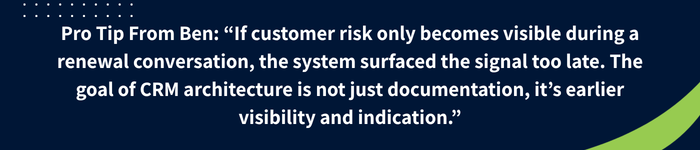
A CRM should do more than store customer history. It should help teams understand what is happening now, where risk may be building, and what requires attention next.
But that only works when the system reflects how the business actually operates in practice.
If fields are inconsistent, handoffs are unclear, or key customer signals are captured across disconnected systems, visibility starts to break down quickly. And when visibility breaks down, teams spend more time reacting to customer risk than identifying it early enough to prevent escalation.
Morgan’s Perspective: Customer Health Is More Than a Score
From the Customer Success perspective, customer risk rarely appears as a single obvious issue. More often, it shows up through subtle changes that are easy to miss if teams rely only on dashboards or status fields.
A customer may appear “healthy” in the CRM, while engagement is already shifting behind the scenes. An executive sponsor may become less responsive, and adoption may stall even though onboarding milestones are technically complete.
A renewal may still be months away, but friction is quietly building in conversations, support interactions, or stakeholder alignment.
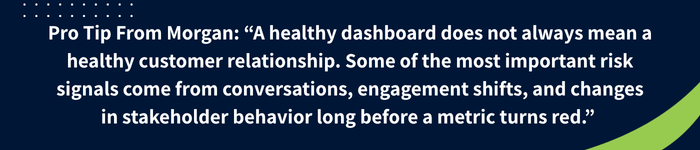
This is why Customer Success cannot rely only on static data points or automated health indicators. Metrics create visibility, but relationship context explains what those signals actually mean.
That context matters because customer risk usually develops gradually. Small signals build over time before they become visible in reporting or forecasts. The earlier teams can identify those signals, the more opportunity they have to respond proactively instead of reactively.
At the same time, CRM architecture cannot be designed in isolation from the realities of customer relationships. Systems are most effective when they reflect how customers actually engage, adopt, escalate concerns, and evolve over time.
The value comes from connecting both perspectives:
- The system captures the signal.
- Customer Success interprets the context.
- Together, teams can identify risks earlier and decide on the next action.
Morgan’s Perspective: Where Customer Risk Slips Through the Cracks
Customer risk rarely develops within a single team. More often, it builds in the spaces between teams, systems, and handoffs where information is fragmented or lacks visibility.
While Sales may understand the expectations set during the buying process, onboarding may identify where implementation momentum slows. Customer Success may recognize early signs of disengagement. Support may notice recurring issues or growing frustration. Product teams may identify patterns in feedback that suggest a broader concern.
Each team holds an important part of the customer story.
The challenge is that those signals are not always connected in a way that creates a clear picture. When information lives across separate workflows, tools, or conversations, teams often see only part of what is happening.
That is where visibility starts to break down.
A missed handoff may seem operational at first, but it can delay implementation progress. Delayed implementation can slow adoption. Slower adoption can weaken customer confidence and increase renewal risk over time.
By the time those issues become visible in a forecast or escalation conversation, the opportunity for early intervention may already be shrinking.
This is why connected visibility matters. The goal is not simply to collect more customer data. It is making sure the right teams can recognize patterns early enough to act before small issues become larger risks.
Ben’s Perspective: Your CRM Should Do More Than Store Activity
Good CRM architecture alone will not eliminate customer risk. But weak architecture almost guarantees teams will identify issues later than they should.
From my perspective, the goal is not to create more process complexity. It is to create operational clarity.
That means asking:
- What information needs to be captured consistently?
- Who owns each stage of the customer lifecycle?
- Which signals should trigger action?
- Where do handoffs happen, or where is the gap?
- What visibility and oversight should leadership have?
- And which data points can teams confidently trust?
A well-designed CRM creates a shared operating model. It gives teams a common language for customer health, lifecycle stage, ownership, escalation signals, and next steps.
It also reduces dependence on tribal knowledge and informal context-sharing.
Because if the only way to understand customer risk depends on finding the right person in the right Slack thread, the system is not doing enough work.

The CRM should make important customer signals easier to see, not harder to find.
Customer Health Is More Than a Score
Customer Success turns customer information into actionable insights. That means going beyond whether a task was completed or a field was updated and understanding what the customer experience actually looks like behind the data.
Customer Success teams are constantly evaluating questions like:
- Is the customer getting meaningful value?
- Are the right stakeholders engaged?
- Are expectations still aligned?
- Is friction building beneath the surface?
- Does this account need more support, clearer communication, or a different next step?
From my perspective, customer health cannot be reduced to a single score or dashboard indicator. Health scores can help create visibility, but they should support judgment, not replace it.
The strongest customer programs combine structured data with real relationship context. The CRM provides visibility into customer activity, milestones, and trends, while Customer Success helps interpret what those signals actually mean in practice.
That is where stronger action comes from.
Not simply recognizing that something changed, but understanding why it matters, what risk may be developing, and what the organization should do next.
When Customer Data Becomes an Early Warning System
When CRM architecture and Customer Success operate in alignment, customer information becomes significantly more actionable.
Teams can identify patterns earlier, leadership gains clearer visibility into where attention is needed, handoffs become more consistent, and customer conversations shift from reactive to proactive.

This is where customer data starts to function less as historical reporting and more as operational risk insight.
A stalled onboarding milestone may signal adoption risk, while a disengaged stakeholder may indicate renewal exposure long before a contract conversation begins. And recurring support trends may reveal broader product, process, or expectation gaps across the customer experience.
The more clearly those signals are connected across systems and teams, the easier it becomes to identify risk early and intervene before issues escalate.
Building One View of the Customer Story
This means designing systems and workflows around the full customer lifecycle, not just individual departmental needs.
Customer Advocacy, Onboarding & Enablement, Customer Success, Product Support, Product, and leadership all require different perspectives into the customer experience, but those perspectives should remain connected through a shared central source of truth. Achieving that alignment requires ongoing partnership between the teams designing systems and the teams using them every day.
That is how we approach the relationship between CRM architecture and Customer Success. While the disciplines are different, the goal is shared: create customer visibility that teams can trust, act on, and connect directly to business outcomes.
The CRM should not only document what happened. It should help teams understand: what is changing across the customer lifecycle, where risk may be building, who owns the next step, and what leadership needs visibility into before issues escalate.
Those are the questions that help customer organizations move beyond reporting activity and toward driving proactive action.
Customer Risk Is Everyone’s Risk
Customer experience is not owned by one team. Neither is customer risk. It lives across systems, handoffs, relationships, and decisions.
That is why alignment between CRM architecture and Customer Success matters. One creates the structure. The other brings the context. Together, they help organizations see the full picture earlier.
At LogicManager, this connects directly to how we think about risk management more broadly.
Risk does not only show up in formal risk registers or annual assessments. It shows up in customer workflows, operational handoffs, system design, and the moments where teams need reliable information to make the right decision.
Strong programs do not just collect information.
- They connect it.
- They create visibility.
- They drive accountability
- They help teams take action before small signals become larger issues.
The Signal Is Usually Already There
Customer risk rarely starts as a surprise. It starts as a signal. The question is whether your teams can see it, understand it, and act on it in time. That is where CRM architecture and Customer Success work best together.
Because when customer signals stay in silos, teams react. When they are connected, teams lead.
Connect Risk Insight Across the Customer Lifecycle
This is the same approach we use to support customers at LogicManager.
We help organizations connect information across teams, processes, systems, and third-party relationships so risk does not stay buried in disconnected workflows. Whether the signal comes from a customer handoff, an audit finding, a vendor issue, an operational process, or a strategic initiative, the value comes from turning that information into visibility, accountability, and action.
If your team is looking for a better way to identify where risk is building, clarify ownership, and help leadership make more informed decisions, we would welcome the conversation. → See how LogicManager helps teams turn risk insight into action