
Our Director of Software Development recently shared how engineering metrics can reveal business risk. Building on that perspective, I’d like to explore what those same metrics can tell us from a People Operations perspective and why shared context is just as important as the data itself.
Performance metrics are often viewed as operational tools, but they are much more than that. They help organizations understand workload, capacity, accountability, collaboration, and organizational health. When interpreted with the right context, they become enterprise-wide insights that support better decisions across every department.
One of the most common assumptions organizations make is that once a metric is defined and measured correctly, everyone will interpret it the same way. In reality, the same metric can tell very different stories depending on who is reviewing it, what decision they are responsible for, and how much context they have about the work behind it.
I see this regularly in People Operations. Metrics help us evaluate workforce performance, understand workload, assess capacity, clarify role accountability, identify contribution gaps, and support organizational planning. But the real value rarely comes from the number itself. It comes from the conversations teams have as they work together to understand what the data is actually telling them and what actions should follow. Before organizations make important decisions, whether about performance, staffing, investments, or priorities, they first need confidence that the information is accurate, consistently defined, and understood within the context of the work being performed.
The Metric Was Accurate. The Interpretation Was Different
A recent discussion illustrated this perfectly. Multiple teams were reviewing capacity planning data, and at first, the conversation centered on process consistency. Different teams were accounting for rollover work differently, and leadership wanted everyone to use the same structure moving forward. That was a reasonable goal, but as the discussion evolved, it became clear that the planner itself was not the real issue.
The challenge was interpretation. One group viewed the metric through the lens of coding activity, another focused on overall capacity, while others considered capitalizable work, planning assumptions, and resource allocation. Everyone was looking at the same information, yet everyone was drawing different conclusions. The data was accurate, but the shared understanding of what it represented had not yet been established.
This experience reinforced an important lesson. Information alone rarely creates alignment. Shared context does. Until people understand how the work connects across functions and how a metric should be interpreted within that context, even accurate information can lead to very different decisions.
Different Stakeholders Need Different Views
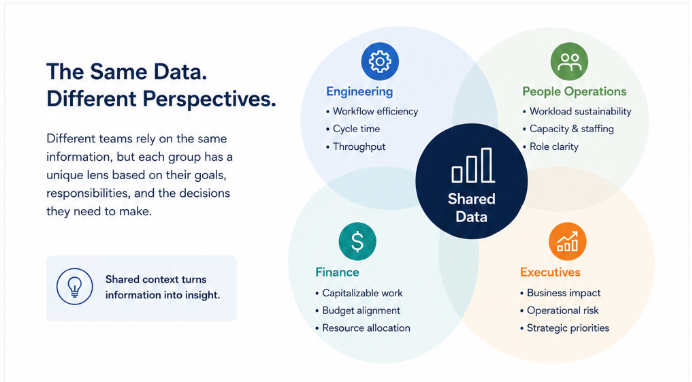
This is where performance metrics become much more than operational reporting. Engineering leaders may be looking for workflow efficiency, Product leaders may be focused on delivery predictability, Finance may need visibility into capitalizable work, and People Operations may be evaluating workload sustainability, role clarity, workforce readiness, contribution reliability, leadership capacity, and organizational performance. Executives, meanwhile, are trying to understand business impact, operational risk, and where leadership attention is needed.
The underlying information may be exactly the same, but the questions each audience is trying to answer are different. The value of a metric is not simply that it exists. Its value comes from helping the right people make better decisions based on information that is relevant to their role.
Connected context is what makes this possible. When every stakeholder sees the same information through a lens designed for the decisions they need to make, data becomes far more valuable than a collection of individual reports. It becomes a shared understanding of how the organization is performing.
When Measurement Doesn’t Reflect the Reality of Work
One of the challenges with performance metrics is that they often measure the primary work while overlooking the activities that make successful outcomes possible. In this example, the capacity planner focused primarily on direct development work, yet successful delivery also depends on planning sessions, technical reviews, documentation, cross-functional collaboration, architecture discussions, requirement clarification, mentoring, knowledge sharing, and the coordination that keeps projects moving. Without a consistent way to account for these responsibilities, organizations risk misattributing performance, overlooking workforce contribution, and making decisions based on incomplete context rather than reliable outcomes.
These activities are not distractions from delivery. They are an essential part of delivery. When measurement structures do not provide a consistent way to account for that work, organizations can unintentionally create debates about the metric instead of conversations about the work itself. The result is often confusion where there should be clarity.
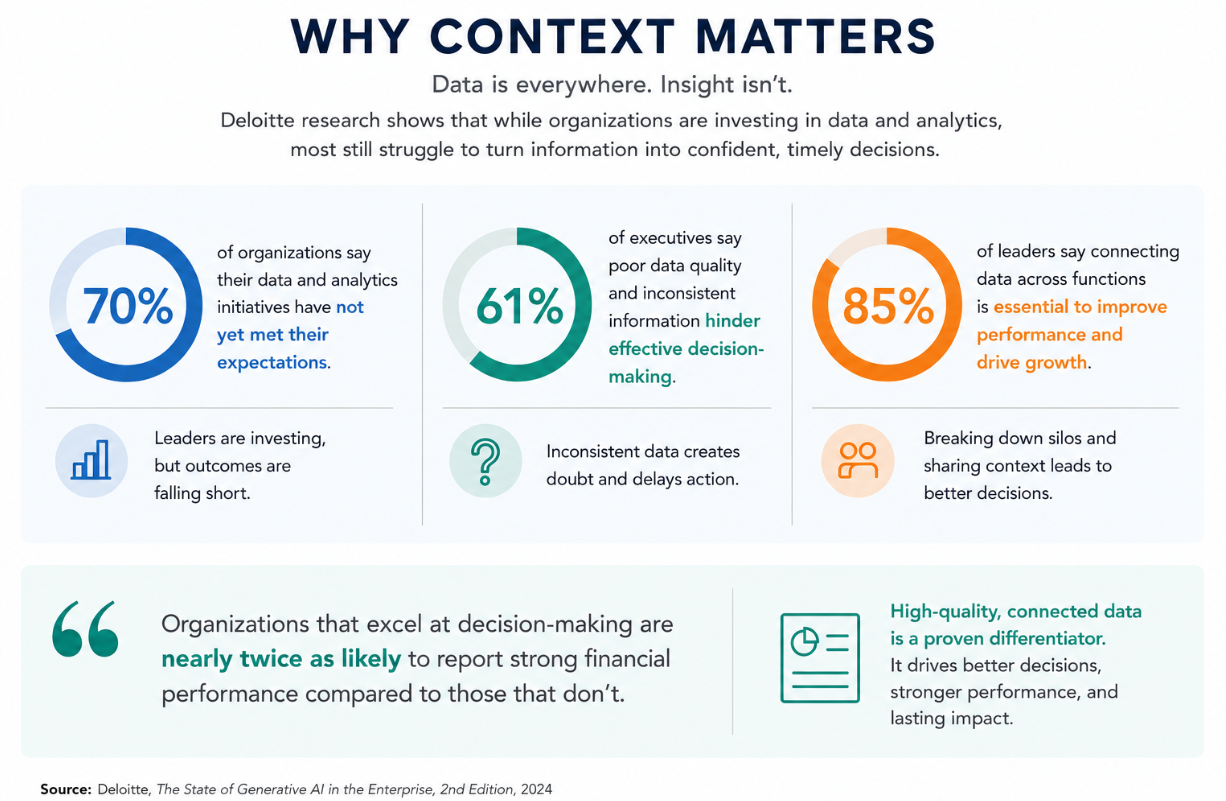
This challenge extends well beyond software development. Organizations are collecting more operational and workforce data than ever before, yet many still struggle to transform that information into timely, actionable insight. Industry research reinforces that the challenge is rarely access to data. It is creating the context needed to make confident decisions.
Metrics Should Start Better Conversations
One of the most important roles People Operations plays is helping organizations use performance data thoughtfully. Metrics should never become shortcuts for judging performance. Instead, they should become signals that encourage better questions and deeper understanding.
Before organizations act on a performance metric, they should pause to validate what the information is actually telling them. Is the metric accurate? Is it consistently defined across teams? Does it reflect the responsibilities, expected contribution, and accountability of the role? Has it been interpreted alongside the work being performed? These questions are often more valuable than the metric itself because good decisions depend on both reliable information and thoughtful interpretation.
Organizations that gain the greatest value from their metrics resist the temptation to jump directly from measurement to conclusion. Instead, they use the information to understand the conditions shaping performance before deciding what action is appropriate. The goal is not to prove whether a metric is right or wrong. The goal is to understand what the metric is trying to tell us. That shift changes the conversation from defending numbers to solving problems.
This Is Bigger Than One Department
This is not solely an Engineering conversation, a Finance conversation, or a People Operations conversation. It is an enterprise conversation because every department depends on accurate information, shared definitions, consistent performance expectations, and accepted accountability to make informed decisions.
When different teams interpret the same information differently, decisions become fragmented and opportunities for alignment are missed. When teams share both data and context, collaboration improves because people understand not only what is happening, but why it matters, how it connects to other work across the organization, and what role they play in achieving better outcomes.
Enterprise visibility is not simply about making more information available. It is about ensuring the right information reaches the right people with enough context to support informed decisions. When leaders share common definitions, evaluate information consistently, and understand how metrics relate to the work behind them, organizations make decisions that are not only faster, but also more equitable, repeatable, and defensible.
Turning Metrics Into Actionable Insight
Once organizations have confidence in the information they are using, metrics become far more than measurements. They become a foundation for stronger conversations, clearer accountability, stronger workforce performance, and more reliable organizational outcomes.
The goal is not to build more dashboards, collect more metrics, or generate more reports. The goal is to create a shared understanding that helps teams align around priorities, identify opportunities, and act with confidence. When organizations connect information, context, ownership, and action, performance metrics become significantly more valuable because they move beyond measurement and begin driving meaningful conversations across the enterprise.
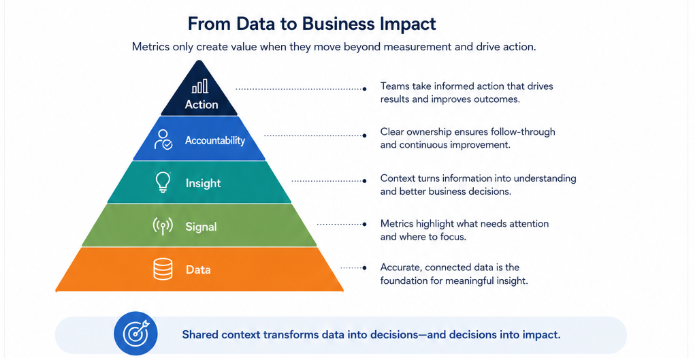
This is where connected context creates real business value. Data becomes a signal. Signals become insight. Insight clarifies accountability. Accountability drives action. Action leads to better business outcomes.
Rather than asking, “What happened?”, organizations begin asking, “What requires attention?”, “Who owns it?”, and “What should happen next?” That shift transforms reporting from a retrospective exercise into a decision-support capability that helps leaders respond earlier, prioritize more effectively, and improve outcomes across the organization.
How LogicManager Helps Organizations Create Connected Context
LogicManager helps organizations connect workforce performance, role accountability, organizational objectives, and operational information so leaders can understand not only what is being performed, but whether the organization has the capacity, capability, and accountability needed to achieve reliable business outcomes. Rather than treating performance metrics, workforce planning, reporting, and operational activities as separate efforts,, the platform creates a connected view of how work, people, and organizational objectives align across the enterprise.
That shared context allows leaders at every level to understand not only what is happening, but why it matters, who owns it, how it connects to broader business objectives, where performance may be at risk, and what decisions should follow.
Engineering gains better visibility into workflow and delivery. Finance gains greater confidence in planning, forecasting, and capitalizable work. People Operations gains visibility into organizational capacity, contribution reliability, role accountability, and emerging talent risks that may affect reliable business outcomes. Executives gain confidence that the information reaching them reflects organizational health across the business rather than isolated snapshots from individual departments.
Performance data should not remain confined to one team’s dashboard. It should become enterprise information that everyone can understand, trust, and use to improve performance, strengthen accountability, and make better decisions.
Performance Insight Is a Shared Responsibility
The best performance conversations are never about defending numbers. They are about understanding what those numbers are telling us. When organizations connect information across people, processes, and functions, metrics become more than measurements. They become a shared language that helps leaders recognize patterns earlier, align around priorities, strengthen accountability, and act with confidence.
Better decisions begin with better understanding. When organizations create a connected context, performance data stops being something teams report on and starts becoming something the entire organization can use to improve outcomes.
Metrics alone do not improve organizations. People do. The organizations that consistently make better decisions are not necessarily the ones with the most data. They are the ones that create confidence in the information they use, apply it consistently, and connect it to accountability, contribution, and action. Metrics provide the visibility, context, and shared understanding that help organizations strengthen performance and make better business decisions.
Learn More
Discover how LogicManager’s Workforce Performance & Talent Risk Program helps organizations define performance expectations, strengthen role accountability, improve readiness, monitor contribution reliability, and identify emerging talent risks before they affect business outcomes. Explore how connected insight empowers leaders across every department to make more informed decisions.