
Your continuity plan names an approver. Your escalation goes to their inbox. Then email becomes unavailable. The test is whether employees can still reach someone authorized to decide, continue within approved limits, and demonstrate that critical work has recovered.
What Happened During the Microsoft Outlook Outage
On November 12, 2026, an Exchange Online disruption affected access to Outlook mailboxes and delayed email delivery. Functions in other Microsoft 365 services that depend on Exchange Online were also affected, according to Microsoft’s service health updates.
The disruption continued into November 13, as reported by the Associated Press. In a November 14 update, Microsoft confirmed that it had addressed the underlying issue and restored service to the remaining affected customers and regions.
With service restored, organizations have an opportunity to check which critical decisions stalled and whether their continuity arrangements worked as intended.
For customers, service restoration leaves a separate responsibility: determining whether delayed approvals, interrupted processes, and outstanding commitments have been resolved.
For organizations that depend on these services, the event raises an immediate question: If your usual communication channel becomes unavailable, can the right people still make and carry out the decisions your business needs?
When a Communication Failure Becomes an Accountability Gap
Consider a customer escalation awaiting approval, a time-sensitive payment requiring review, or an operational exception that needs a decision before work can continue.
The disruption can also extend across organizational boundaries. If employees cannot reach a critical vendor, they may be unable to confirm a delivery, escalate a service issue, or obtain information needed to keep operations moving. This creates a third-party risk question: Who owns the vendor relationship, what alternate communication channel is available, and who can authorize a response if the vendor cannot be reached?
In each case, the organization may have a policy, a responsible employee, and an established process. Yet that process can stall if the request, authorization, and escalation all depend on the same unavailable service.
Imagine an operations manager who identifies a deadline at risk and sends an urgent approval request. The message is delayed. The designated approver does not see it. Other employees know the work is blocked, but nobody knows whether an alternate decision-maker has authority to intervene.
The information exists. The business consequence is developing. The connection to an authorized decision remains incomplete.
The warning is known within the organization, but it has not reached someone with the information and authority to act. This is an “unknown known”: knowledge exists, yet remains disconnected from the decision it should inform. The example illustrates a continuity scenario organizations can test; it does not describe Microsoft’s internal response.
An outage does not have to originate inside your organization to expose weaknesses in how your organization assigns responsibility.
When Work Changes, Decision Rights Need to Change With It
When a role is eliminated, a team is reorganized, or a task becomes automated, approval authority, exception handling, and review responsibilities need to be reassigned explicitly.
A workflow may continue running even after the person who understood its exceptions has moved on. During a disruption, that gap becomes operational: work waits, employees improvise, or decisions reach someone who lacks authority to approve them.
AI can support analysis and reduce repetitive work. People still need the expertise, information, and authority to challenge a recommendation, approve an exception, and verify the outcome.
Before changing how work gets done, identify who will own those decisions and confirm that they can act when normal operations are interrupted.
What Human in the Loop Must Mean in Practice
Adding a person to a notification list does not establish an effective human review.
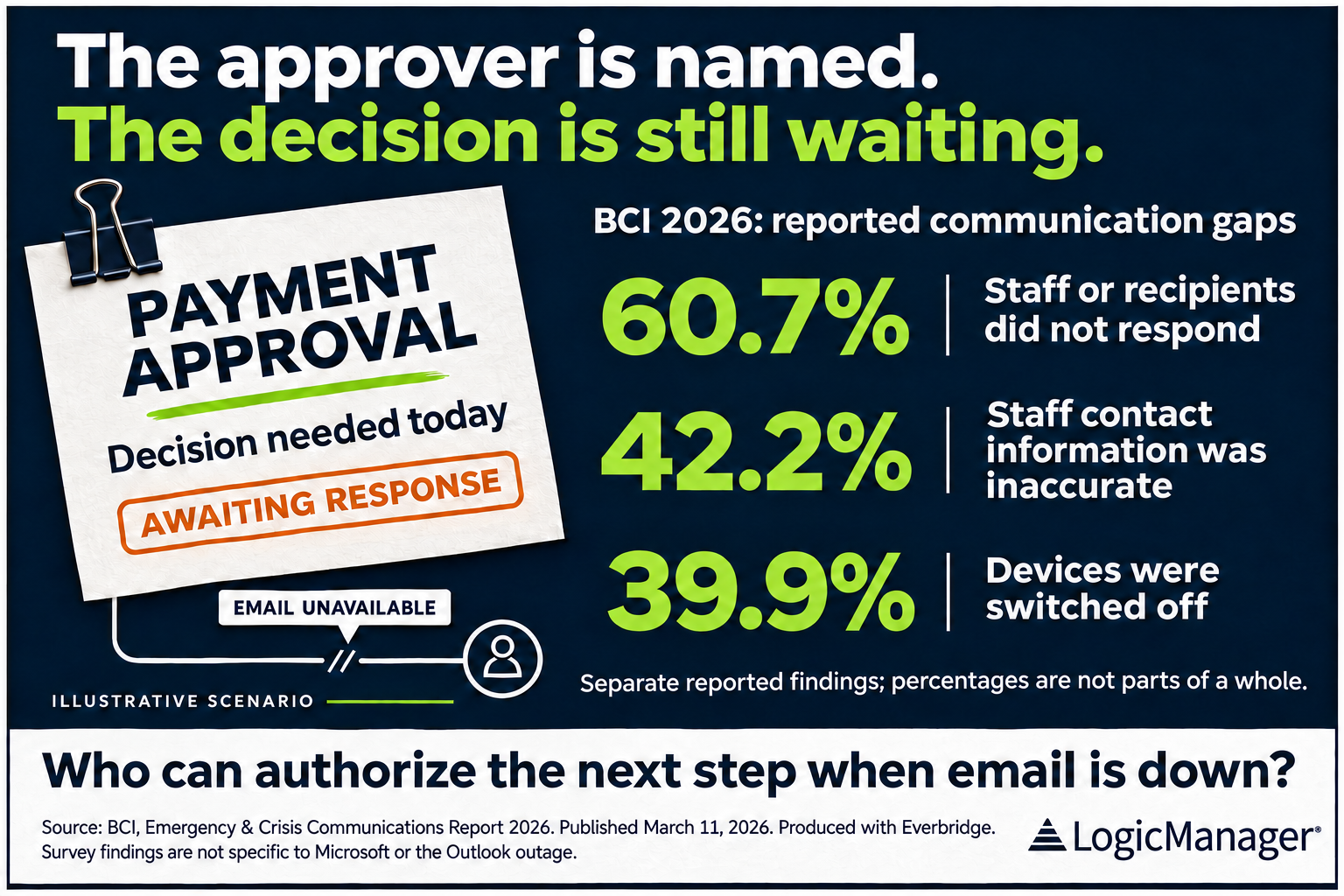
An assigned approver is only useful if the escalation reaches them. Test the alternate contact route and decision authority before normal communications become unavailable.
Source: Business Continuity Institute, Emergency & Crisis Communications Report 2026.
The person needs timely information, appropriate expertise, authority to intervene, and a practical way to act. They also need a defined escalation path when the issue exceeds their authority or they cannot be reached.
During a service disruption, that means asking:
- Who decides when to activate an alternate process?
- Can that person receive the escalation without relying on the affected service?
- Who authorizes any temporary exception to normal controls?
- Who checks the resulting work and confirms that outstanding obligations have been addressed?
Where the exposure warrants separation of duties, the person carrying out a workaround should not be its sole approver or the sole reviewer of whether it worked. Define those responsibilities before an urgent exception makes them difficult to separate.
Human involvement becomes meaningful when the organization can show how a person evaluated the situation, exercised authority, and followed through.
Defensible Oversight Continues Through Recovery
A vendor’s restoration update is an important input. Your organization also needs to determine whether its own business processes have recovered.
For example, restored mailbox access may leave delayed requests, missed approvals, or unresolved customer issues requiring attention. An employee may have used an authorized alternate channel, creating records that need to be reconciled with the normal process.
Leadership needs visibility into those consequences and the decisions made to address them.
Defensible Oversight means being able to explain what the organization knew, who evaluated the exposure, what response was authorized, and how the outcome was checked. It also means identifying what remains unresolved and who owns the next decision.
That evidence helps executives and boards assess whether the response protected business objectives and where further action is required.

Five Lessons to Apply Before the Next Disruption
1. Test the decisions your continuity plan depends on.
Choose a critical process and make its usual communication channel unavailable during an exercise. Can employees locate the plan, reach an authorized decision-maker, and continue within approved limits? Record where the process stalls, assign an owner and deadline for corrective action, and repeat the exercise to confirm that the gap has been resolved.
2. Review accountability when staffing or automation changes.
Reassign approval authority, escalation coverage, and verification responsibilities explicitly. Confirm that the receiving person understands and accepts the responsibility, including coverage during absences or disruptions.
3. Evaluate shared dependencies across departments.
Check whether primary communication, backup communication, approval workflows, and access to recovery instructions rely on common services. Several documented alternatives can still share a dependency that makes them unavailable together.
4. Preserve control over temporary workarounds.
Define who may approve an exception, the limits of that approval, and when it expires. Keep enough evidence to review what occurred and reconcile work when normal service resumes.
5. Verify business recovery before closing the issue.
Have process owners confirm that critical work has resumed and outstanding items have been reconciled. Use review proportionate to the exposure, with sufficient independence where needed. Give leadership a clear view of remaining exceptions and decisions.
Can You Trace the Decision When the System Goes Down?
Before the next disruption, test one critical process. Identify the business objective it protects, the services it depends on, who can authorize an alternate response, and what evidence will demonstrate recovery.
Examine whether those connections remain usable when the primary communication channel is unavailable. A documented approver offers limited protection if employees cannot reach that person or identify an authorized alternate.
LogicManager connects risks, controls, vendors, and business processes to help organizations understand shared exposure and coordinate accountable action. The value is in making the information, responsibilities, and follow-through visible before a disruption forces employees to reconstruct them.
At the next board meeting or leadership review, a service restoration notice will answer only part of the question. Leadership also needs to know which commitments were affected, which exceptions were authorized, and what remains unresolved.
Take the 2-minute Accountability Gap Assessment to identify where gaps in visibility, responsibility, and follow-through may leave critical decisions unsupported.